I was born in 1957. So I will be turning 60 in 2017, hence the 12 months between July 6, 2016 and July 6, 2017 is the year I am turning 60. I blogged about turning 50 ten years ago, so I figured I would do the same thing again. Starting in three weeks.
Thursday, July 6, 2017
Working in a Coal Mine
Come listen you fellers, so young and and so fine
and seek not your fortune in the dark dreary mine
It will form as a habit, and seep in your soul
'til the stream of your blood runs as black as the coal.
Since I spent all my money traveling to Peru, and working for free for six days a week, I had to find another way to pay tuition, room, and board. Luckily for me, mining was still an expanding field at the time. (Remember, oil prices were pretty high back then. And coal was a substitute for oil, and you know from econ 101 what happens next) So I was able to get a "co-op" job at the Consolidation Coal Company's Hillsboro Mine. (Co-op jobs generally lasted a semester. I took a semester and a summer each time.) So in January of 1997, I moved down to Greenville, IL, and started my work in the mine.
This was an underground mine (since closed down) that was mining Illinois Number 7 (Danville) Coal. This was part of a mine-mouth complex that served an Illinois Power plant. It was located just south of Coffeen, IL:
View Hillsboro Mine in a larger map
It was a good sized, and fairly old mine:
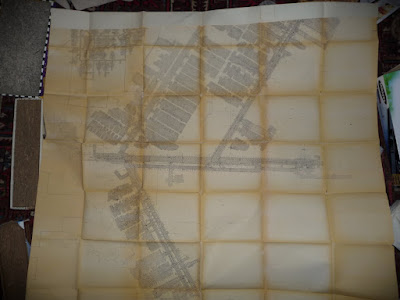
That is a map(looking down) at the mine. We did what was called "Room and Pillar" mining, where you took a bite out of the coal in long entries, and then cross-cuts leaving pillars of coal to hold up the roof:
The pillars were about 50' across, the entries about 16' wide. If I recall correctly we recovered only about 40% of the coal. Other techniques (Longwall mining) recovered much more.
The "continuous miners" were huge machines that chewed up the coal with teeth like this:
The miners themselves looked like this:
We would occasionally use a method called "Pillar Robbing" as we were leaving (retreating from) a section:
YOU can see the "robbed" pillars in the lower portion of this map. You can also see that we couldn't mine under cemeteries. Mineral rights issues.
The mine was about 700' underground. We had two "tipples" one for people, one for coal. This is the Man Tipple:
I spent about half my time underground, half surveying land rights, and half in the office:
We had a small staff, and this was a small town in southern Illinois:
Look at those tools on the wall. French curves, protractors, etc. We used those.
I was living there when Elvis died.
and seek not your fortune in the dark dreary mine
It will form as a habit, and seep in your soul
'til the stream of your blood runs as black as the coal.
-Merle Haggart
![]() |
| From Illinois |
Since I spent all my money traveling to Peru, and working for free for six days a week, I had to find another way to pay tuition, room, and board. Luckily for me, mining was still an expanding field at the time. (Remember, oil prices were pretty high back then. And coal was a substitute for oil, and you know from econ 101 what happens next) So I was able to get a "co-op" job at the Consolidation Coal Company's Hillsboro Mine. (Co-op jobs generally lasted a semester. I took a semester and a summer each time.) So in January of 1997, I moved down to Greenville, IL, and started my work in the mine.
This was an underground mine (since closed down) that was mining Illinois Number 7 (Danville) Coal. This was part of a mine-mouth complex that served an Illinois Power plant. It was located just south of Coffeen, IL:
View Hillsboro Mine in a larger map
It was a good sized, and fairly old mine:
| From Illinois |
That is a map(looking down) at the mine. We did what was called "Room and Pillar" mining, where you took a bite out of the coal in long entries, and then cross-cuts leaving pillars of coal to hold up the roof:
| From Illinois |
The pillars were about 50' across, the entries about 16' wide. If I recall correctly we recovered only about 40% of the coal. Other techniques (Longwall mining) recovered much more.
The "continuous miners" were huge machines that chewed up the coal with teeth like this:
| From Illinois |
The miners themselves looked like this:
![]() |
| From Illinois |
We would occasionally use a method called "Pillar Robbing" as we were leaving (retreating from) a section:
| From Illinois |
YOU can see the "robbed" pillars in the lower portion of this map. You can also see that we couldn't mine under cemeteries. Mineral rights issues.
The mine was about 700' underground. We had two "tipples" one for people, one for coal. This is the Man Tipple:
![]() |
| From Illinois |
I spent about half my time underground, half surveying land rights, and half in the office:
![]() |
| From Illinois |
We had a small staff, and this was a small town in southern Illinois:
| From Illinois |
Look at those tools on the wall. French curves, protractors, etc. We used those.
I was living there when Elvis died.
That's spelled K-E-Double M-Double ER
I stayed in Illinois for eight months - from January of 1977 to August of 1977. I then went back to Madison (and had a great apartment - I lived above the Chocolate Shoppe on the corner of Gilman and State):
View Larger Map
I stayed in school for two semesters - September 1977 to May of 1978. Then I had to go back to work to pay for more school. I ended up at the Kemmerer Coal Company in Kemmerer (that is pronounced "Kemmer"), Wyoming.
I don't have many photos of Kemmerer, for some reason I was shooting slides at the time.
I got to Kemmerer in June of 1977. There is an interesting story about my ride (I was driving a 1965 Mercedes 220S at the time) that you can see here.
At the Kemmerer Coal Company I was paid well to do real engineering "stuff". Mainly surveying. You were outside all day, wandering around the wilds of southwestern Wyoming, at about 8,000' elevation. IT was, at times invigorating, and sometimes very boring, depending on who the party chief was.
View Larger Map
We had a couple of young engineers there who did not really like to work too hard. So when I was assigned to one of their crews we took maybe three shots a day, and then spent the afternoon in bars. I figured that is how the real world works. Good training for a young engineer!
But when you worked with the Survey Chief you worked pretty hard. Now this guy - I will call him Bob Savage, because that is his name, was the original hard luck story.
Bob grew up in New Mexico, and had a hard luck childhood. (He must have been about 40 in 1978.) So to get out of the state, he joined the Navy. He wanted to see the world. The Navy made him a dental technician and sent him to the Mojave Desert, where he spent his pull cleaning teeth.
He ended up in Kemmerer after he flew up for an interview with the Mine Engineer. They got along fine, he was offered the job, and told to show up three weeks later. He returned to NM to get his family and things, drove back to Kemmerer and showed up at the appointed time.
When he got to the mine, there was nobody in the office. He waited, and finally some people started trickling in. He asked to see the Mine Engineer, and was met with a shocked silence. The Engineer had passed away in the intervening three weeks. Of course, there was no record of him being offered a job.
But they did need a job, and hired him, to his relief.
This bad luck extended to his whole life. Once, I was in the office with my crew (I was on e drilling crew at the time) and one of my guys kicked my truck out of gear leaving the vehicle. The truck rolled down, and guess whose car it ran into? You're right, Bob Savage's car.
Another time he was giving a fellow worker a ride home (the other fellow's car was in the shop) and had to stop and make a left turn he ordinarily would not make. The car behind him did not stop, and slammed into his car. The fellow he was giving a ride to was a big guy, and the car hit with such force the he broke the passenger side seat. No ticket was issued, and Bob had to pay for the entire repair.
Often times while surveying, we had downtime. We used that time to either play hearts (for money) or backgammon (also for money). Bob always lost. SO to make up his losses (which he didn't tell his wife about) he would throw the doubling cube on his FIRST ROLL!!! Now, if you ever play backgammon, you know that puts you in a sever disadvantage. I asked if he just wanted to raise the stakes, but that would not do.
Finally, while I was still living in Wyoming, Bob's wife joined some sort of a religious cult that did not believe in sex.
Poor bob.
I may have to make this post two posts.
This is the mine:
View Larger Map
That is the pit we called 1-U-d.
More in my next post. Where I will talk about this, too:
View Larger Map
I stayed in school for two semesters - September 1977 to May of 1978. Then I had to go back to work to pay for more school. I ended up at the Kemmerer Coal Company in Kemmerer (that is pronounced "Kemmer"), Wyoming.
I don't have many photos of Kemmerer, for some reason I was shooting slides at the time.
I got to Kemmerer in June of 1977. There is an interesting story about my ride (I was driving a 1965 Mercedes 220S at the time) that you can see here.
At the Kemmerer Coal Company I was paid well to do real engineering "stuff". Mainly surveying. You were outside all day, wandering around the wilds of southwestern Wyoming, at about 8,000' elevation. IT was, at times invigorating, and sometimes very boring, depending on who the party chief was.
View Larger Map
We had a couple of young engineers there who did not really like to work too hard. So when I was assigned to one of their crews we took maybe three shots a day, and then spent the afternoon in bars. I figured that is how the real world works. Good training for a young engineer!
But when you worked with the Survey Chief you worked pretty hard. Now this guy - I will call him Bob Savage, because that is his name, was the original hard luck story.
Bob grew up in New Mexico, and had a hard luck childhood. (He must have been about 40 in 1978.) So to get out of the state, he joined the Navy. He wanted to see the world. The Navy made him a dental technician and sent him to the Mojave Desert, where he spent his pull cleaning teeth.
He ended up in Kemmerer after he flew up for an interview with the Mine Engineer. They got along fine, he was offered the job, and told to show up three weeks later. He returned to NM to get his family and things, drove back to Kemmerer and showed up at the appointed time.
When he got to the mine, there was nobody in the office. He waited, and finally some people started trickling in. He asked to see the Mine Engineer, and was met with a shocked silence. The Engineer had passed away in the intervening three weeks. Of course, there was no record of him being offered a job.
But they did need a job, and hired him, to his relief.
This bad luck extended to his whole life. Once, I was in the office with my crew (I was on e drilling crew at the time) and one of my guys kicked my truck out of gear leaving the vehicle. The truck rolled down, and guess whose car it ran into? You're right, Bob Savage's car.
Another time he was giving a fellow worker a ride home (the other fellow's car was in the shop) and had to stop and make a left turn he ordinarily would not make. The car behind him did not stop, and slammed into his car. The fellow he was giving a ride to was a big guy, and the car hit with such force the he broke the passenger side seat. No ticket was issued, and Bob had to pay for the entire repair.
Often times while surveying, we had downtime. We used that time to either play hearts (for money) or backgammon (also for money). Bob always lost. SO to make up his losses (which he didn't tell his wife about) he would throw the doubling cube on his FIRST ROLL!!! Now, if you ever play backgammon, you know that puts you in a sever disadvantage. I asked if he just wanted to raise the stakes, but that would not do.
Finally, while I was still living in Wyoming, Bob's wife joined some sort of a religious cult that did not believe in sex.
Poor bob.
I may have to make this post two posts.
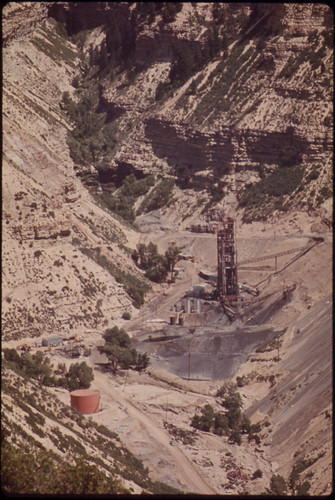
This is the mine:
View Larger Map
That is the pit we called 1-U-d.
More in my next post. Where I will talk about this, too:
|
|
| From Wyoming, Wind River Range, 1979 |
Kemmerer, Continued
Here I am in 1978, somewhere near the Grand Tetons:
The apartment I rented in Kemmerer looked like this is 1978:
and last week from Google Street View:
View Larger Map
I guess you could say that not too much has changed in Kemmerer in the past 33 years.
The Kemmerer Coal mine was unusual in a couple of aspects. First, it was still an independent mine. (It was later purchased by Pittsburgh and Midway)Second, and more interestingly, the coal was dipping to the west at about 17 degrees:
and:
That meant that we ran the mine closer to a classic "Open Pit" mine - with a high wall and a foot wall than a "Strip Mine" which moved "strips" of overburden to the side to get at the coal underneath.
Here is a good view of the "Big Pit" that you can still see in the satellite images from the previous post:
Our main coal seam was 100' thick, high BTU and low sulfur. Good coal, in other words. Because it was good coal, it had been mined for years. Mostly, it was mined underground.
Because old maps were not reliable, we had to try and find these old mines with a drilling rig. One of my jobs in Kemmerer was to be the engineer on the void detection rig. It was a reverse circulation rig, which meant that the drilling fluid (mostly water, in our case) when down the annulus, and the cuttings came up the center of the drill pipe:
It was an interesting job - my crew was two guys, Manny and Leonard. They knew much more about it than I did, and they certainly made me know it. It was fun, to tell you the truth.
The terrain around Kemmerer was not the most exciting in Wyoming. Here is a typical Lincoln County Vista:
But you get a little farther away, say to Pinedale, and you see things like this:
We were also near a ghost town named Sublette. It had been a trona mining town, but the trona played out:
get a little father away, and you see some really spectacular things:
The Grand Tetons, my favorite National Park.
also, Yellowstone:
and some other relief nearby:
Finally, here is a photo of my car at the time. One would imagine that a 1965 Mercedes 220S purchased for $450 would not be the best ride for someone working in a coal mine in Kemmerer, WY - a town of no more than 3,000 souls. In that, one would be correct. But the car made it there, and back to Madison with limited downtime.
![]() |
| From Wyoming Images from Slides |
The apartment I rented in Kemmerer looked like this is 1978:
![]() |
| From Wyoming Images from Slides |
and last week from Google Street View:
View Larger Map
I guess you could say that not too much has changed in Kemmerer in the past 33 years.
The Kemmerer Coal mine was unusual in a couple of aspects. First, it was still an independent mine. (It was later purchased by Pittsburgh and Midway)Second, and more interestingly, the coal was dipping to the west at about 17 degrees:
![]() |
| From Wyoming Images from Slides |
and:
![]() |
| From Wyoming Images from Slides |
That meant that we ran the mine closer to a classic "Open Pit" mine - with a high wall and a foot wall than a "Strip Mine" which moved "strips" of overburden to the side to get at the coal underneath.
Here is a good view of the "Big Pit" that you can still see in the satellite images from the previous post:
![]() |
| From Wyoming Images from Slides |
Our main coal seam was 100' thick, high BTU and low sulfur. Good coal, in other words. Because it was good coal, it had been mined for years. Mostly, it was mined underground.
Because old maps were not reliable, we had to try and find these old mines with a drilling rig. One of my jobs in Kemmerer was to be the engineer on the void detection rig. It was a reverse circulation rig, which meant that the drilling fluid (mostly water, in our case) when down the annulus, and the cuttings came up the center of the drill pipe:
![]() |
| From Wyoming Images from Slides |
It was an interesting job - my crew was two guys, Manny and Leonard. They knew much more about it than I did, and they certainly made me know it. It was fun, to tell you the truth.
The terrain around Kemmerer was not the most exciting in Wyoming. Here is a typical Lincoln County Vista:
![]() |
| From Wyoming Images from Slides |
But you get a little farther away, say to Pinedale, and you see things like this:
![]() |
| From Wyoming Images from Slides |
We were also near a ghost town named Sublette. It had been a trona mining town, but the trona played out:
![]() |
| From Wyoming Images from Slides |
get a little father away, and you see some really spectacular things:
![]() |
| From Wyoming Images from Slides |
The Grand Tetons, my favorite National Park.
also, Yellowstone:
![]() |
| From Wyoming Images from Slides |
and some other relief nearby:
![]() |
| From Wyoming Images from Slides |
Finally, here is a photo of my car at the time. One would imagine that a 1965 Mercedes 220S purchased for $450 would not be the best ride for someone working in a coal mine in Kemmerer, WY - a town of no more than 3,000 souls. In that, one would be correct. But the car made it there, and back to Madison with limited downtime.
![]() |
| From Wyoming Images from Slides |
Exxon Minerals, My First Real Job.
1980 was a challenging year to be graduating from college for most people:
Unemployment was high, inflation was high:
and oil prices were the reason:
Oil prices and all natural resources were expensive. That made Mining Engineers one of the most highly paid BS degrees that year.
I was an odd sort of Mining Engineer, however. I loved cities, and disliked small towns. I liked the math and physics, and didn't really revel in the field work. I wanted to find a job that would let me have it all
I had four "site visits" and five job offers. Lafayette with ARCO. San Francisco with Bechtel. Houston with Shell. Gillette, WY with Exxon Coal. Last, late, and my first choice was Houston with Exxon Minerals. (Hard rock mining is the prize for most mining engineers. Most coal mines (unlike Kemmerer, below) are strip mines - little more than glorified earth moving assignments)
It was a hard decision at the time. The Minerals job was very late in coming, and I had already accepted the job in Gillette (yes, it is called "razor city"). Luckily, I could tell them with a straight face that another Exxon company wanted me. The Coal folks were not happy.
It was a great thing for me, though. When I showed up at the office, (Dresser Tower, Downtown Houston) I was in heaven:
My boss, Jim Grenias (God bless you Jim, wherever you are!) greeted me with a huge handshake and shouting "Christmas came early this year!" (I started 14 July, 1980) There are few memories I have that are better than that moment.
The reality was slightly less rosy. I was in new job in a brand new company that Exxon started to get into the mining business. Exxon had decided that they were not going to buy an existing mining company (like ARCO or Amoco did) but build a "world class"minerals mining company from scratch. That was us. (and Esso Eastern)
The mine I was assigned to was called Pinos Altos near Silver City, NM.
View Larger Map
It was a sweet little copper/zinc mine. How sweet? Well, the geologists did such a good job that they hit mineralization on the first diamond drill. And you could see it in the cores:
I cannot say where I got those photos, but they are photos of the core samples from Pinos Altos. Nice, eh?
I did engineering things like economic analysis of the mine, and then studies trying to figure out what kind of haul trucks to buy:
Now, is that engineering, or what? I even used calculus! When was the last time you used calculus in your job? (Note the date on that report. 5 Feb, 1981. 30 years almost to the day of this post)
The problem was that the mineralization was not nearly as extensive as we had hoped. And copper prices were dropping like a rock. ( $2,233/t in 1980 to $1,856/t in 1981.)
So shortly after I was told that I was to move to the mine and act as the Mine Engineer, the project was canceled.
Exxon was good, though. They told me that they knew what was best for me. Then, as now, those sorts of comments did not sit well with me. But in retrospect, they were probably right. They told me they wanted to get me into their computer group. In particular their data management function (A DB administrator, actually).
I told them they were crazy, that went to school to be a mining engineer, and a mining engineer is what I was going to be.
The story continues, and the irony becomes apparent in only a year or so down the road.
![]() |
| From Houston 1980 |
Unemployment was high, inflation was high:
![]() |
| From Houston 1980 |
and oil prices were the reason:
![]() |
| From Houston 1980 |
Oil prices and all natural resources were expensive. That made Mining Engineers one of the most highly paid BS degrees that year.
I was an odd sort of Mining Engineer, however. I loved cities, and disliked small towns. I liked the math and physics, and didn't really revel in the field work. I wanted to find a job that would let me have it all
I had four "site visits" and five job offers. Lafayette with ARCO. San Francisco with Bechtel. Houston with Shell. Gillette, WY with Exxon Coal. Last, late, and my first choice was Houston with Exxon Minerals. (Hard rock mining is the prize for most mining engineers. Most coal mines (unlike Kemmerer, below) are strip mines - little more than glorified earth moving assignments)
It was a hard decision at the time. The Minerals job was very late in coming, and I had already accepted the job in Gillette (yes, it is called "razor city"). Luckily, I could tell them with a straight face that another Exxon company wanted me. The Coal folks were not happy.
It was a great thing for me, though. When I showed up at the office, (Dresser Tower, Downtown Houston) I was in heaven:
![]() |
| From Houston 1980 |
My boss, Jim Grenias (God bless you Jim, wherever you are!) greeted me with a huge handshake and shouting "Christmas came early this year!" (I started 14 July, 1980) There are few memories I have that are better than that moment.
The reality was slightly less rosy. I was in new job in a brand new company that Exxon started to get into the mining business. Exxon had decided that they were not going to buy an existing mining company (like ARCO or Amoco did) but build a "world class"minerals mining company from scratch. That was us. (and Esso Eastern)
The mine I was assigned to was called Pinos Altos near Silver City, NM.
View Larger Map
It was a sweet little copper/zinc mine. How sweet? Well, the geologists did such a good job that they hit mineralization on the first diamond drill. And you could see it in the cores:
| From Houston 1980 |
| From Houston 1980 |
| From Houston 1980 |
I cannot say where I got those photos, but they are photos of the core samples from Pinos Altos. Nice, eh?
I did engineering things like economic analysis of the mine, and then studies trying to figure out what kind of haul trucks to buy:
Now, is that engineering, or what? I even used calculus! When was the last time you used calculus in your job? (Note the date on that report. 5 Feb, 1981. 30 years almost to the day of this post)
The problem was that the mineralization was not nearly as extensive as we had hoped. And copper prices were dropping like a rock. ( $2,233/t in 1980 to $1,856/t in 1981.)
So shortly after I was told that I was to move to the mine and act as the Mine Engineer, the project was canceled.
Exxon was good, though. They told me that they knew what was best for me. Then, as now, those sorts of comments did not sit well with me. But in retrospect, they were probably right. They told me they wanted to get me into their computer group. In particular their data management function (A DB administrator, actually).
I told them they were crazy, that went to school to be a mining engineer, and a mining engineer is what I was going to be.
The story continues, and the irony becomes apparent in only a year or so down the road.
Moving To Colorado to mine Oil Shale
Pinos Altos was shut down because of low commodity prices. It was a small mine that would have yielded a small return. About a month after I agreed to move to New Mexico, the big dog from Exxon Minerals told us we would not be starting that project.
So now I needed to find another job.
Exxon Minerals wanted to make me a DataBase administrator, as I intimated in my last post. But I knew better - I wanted to be an Engineer.
So I called up the head of HR for the Colony Project. Colony was one of the big oil shale projects going on at the time:

Oil Shale (a misnomer. It has kerogen, not oil, and it was a marlstone, not shale) was a messy expensive way to get a liquid hydrocarbon. The highest grade shale we had was about 1 bbl/ton. That is right, about one barrel of oil per ton of rock. That meant that in order to produce the 50,000 bbl per day we were planning on we would have to process almost 70,000 tons of shale.
The capital cost for that project was going to be about $5 billion. Even a cursory glance at the economics shows that is not a good deal. So I should not have been (and indeed, wasn't) surprised about a year later when the inevitable happened.
In the meantime, however, I had a great time.
I was responsible for a couple of things - one was the selection of roof bolters:
These machines place "resin" bolts into the roof to help maintain its integrity. (ie, so it won't fall down). You would drill a hole,. stick a tube with an epoxy like paste inside (a plastic tube with two components that would remain soft when separate, but would harden when mixed together), then stick a pieces of rebar into the hole and spin it. You then press it against the roof with a header board (a 2x4) and let it set for about 30 seconds.
I was also responsible for getting the mine layout into the computer. This was 1981 remember, so it was a mainframe computer located in Houston - and we were in Denver. It was a painstaking exercise that never really worked out that well.
In the end, the mine was canceled. Probably a good thing, too. There would have been all sorts of deleterious environmental consequences to that mine. Water, dust, people.
I enjoyed living in Denver for that year, but fate would bring me back to Houston next.
So now I needed to find another job.
Exxon Minerals wanted to make me a DataBase administrator, as I intimated in my last post. But I knew better - I wanted to be an Engineer.
So I called up the head of HR for the Colony Project. Colony was one of the big oil shale projects going on at the time:

Oil Shale (a misnomer. It has kerogen, not oil, and it was a marlstone, not shale) was a messy expensive way to get a liquid hydrocarbon. The highest grade shale we had was about 1 bbl/ton. That is right, about one barrel of oil per ton of rock. That meant that in order to produce the 50,000 bbl per day we were planning on we would have to process almost 70,000 tons of shale.
The capital cost for that project was going to be about $5 billion. Even a cursory glance at the economics shows that is not a good deal. So I should not have been (and indeed, wasn't) surprised about a year later when the inevitable happened.
In the meantime, however, I had a great time.
I was responsible for a couple of things - one was the selection of roof bolters:
| From Some Old Photos scanned 10.29.05 |
| From Some Old Photos scanned 10.29.05 |
These machines place "resin" bolts into the roof to help maintain its integrity. (ie, so it won't fall down). You would drill a hole,. stick a tube with an epoxy like paste inside (a plastic tube with two components that would remain soft when separate, but would harden when mixed together), then stick a pieces of rebar into the hole and spin it. You then press it against the roof with a header board (a 2x4) and let it set for about 30 seconds.
I was also responsible for getting the mine layout into the computer. This was 1981 remember, so it was a mainframe computer located in Houston - and we were in Denver. It was a painstaking exercise that never really worked out that well.
In the end, the mine was canceled. Probably a good thing, too. There would have been all sorts of deleterious environmental consequences to that mine. Water, dust, people.
I enjoyed living in Denver for that year, but fate would bring me back to Houston next.
Leaving Mining Behind
When the Colony Oil Shale project was shut down, on May 2, 1982 I knew my days at Exxon were numbered. I had had several run-ins with my boss (he had rules. I didn't like them. Plus, he was Canadian. And we all know what that means) and it was obvious that Exxon was getting out of the mining business. So I started looking for work.
I was lucky. Even in 1982, I was able to find good work. I was offered a job as an engineer with Goldfield Exploration to act as the mine engineer in their heap leach mine in either Lovelock, NV:
View Larger Map
or in Goldfield, NV:
View Larger Map
I have to say that I was not too excited about either prospect.
SO I took a job back in Houston (this is the second time I have moved to Houston) with a small software company called David P. Cook and Associates.
The Company delivered "time shared" software that calculated the economics of oil and gas wells. You told it how much oil or gas you would produce, how long it would be producing, how much it cost to drill, and the software would tell you how much money you would make.
We had a DEC 2060 main frame computer, into which the clients would connect using a dial up modem (originally an "acoustically coupled" modem that would deliver 300 baud, or 300 characters per second data transfer rate).
I was hired as a Customer Support representative. When clients would call to find out how to address a specific problem, then would talk to me. It gave me great insight to the oil and gas world. And the world of economics. And the world of software.
We mostly used a hardcopy terminal to run these evaluations - usually a TI 820:
I was convinced that David could tell the future. He was only 30 years old, but had taken the company public the year I joined. He also refused to use the money he raised to grow the company. He told me that he was sure that oil prices would crash, and the company would fail.
As you can imagine the stock price dropped from $16.00 to about $2.00 but he stuck to his guns. He was sued, and he had to issue additional shares to the original shareholders.
We were talking one day and he said that what the US needed at that moment was a video rental store that always had the video you wanted, didn't have pro, and could remember what you liked. We all laughed - it was obvious that Kroger's, or Walgreen's, or some other retail store would soon own the video rental business. But he went ahead and started Blockbuster Video anyway. Needless to say it was a great success.
In the mean time he spun off the software side the business. We got hit hard by two trends - much lower oil prices and personal computers.
This is a good example of a company not being able to adjust to externalities. The price of our products and services was dropping to almost nothing, and the demand was falling through the floor.
We adjusted a bit, but it was not really enough. I was let go in July of 1986, (into the teeth of the Great Oil Depression) and was looking for work again.
I was lucky. Even in 1982, I was able to find good work. I was offered a job as an engineer with Goldfield Exploration to act as the mine engineer in their heap leach mine in either Lovelock, NV:
View Larger Map
or in Goldfield, NV:
View Larger Map
I have to say that I was not too excited about either prospect.
SO I took a job back in Houston (this is the second time I have moved to Houston) with a small software company called David P. Cook and Associates.
The Company delivered "time shared" software that calculated the economics of oil and gas wells. You told it how much oil or gas you would produce, how long it would be producing, how much it cost to drill, and the software would tell you how much money you would make.
We had a DEC 2060 main frame computer, into which the clients would connect using a dial up modem (originally an "acoustically coupled" modem that would deliver 300 baud, or 300 characters per second data transfer rate).
![]() |
| From Houston 1980 |
![]() |
| From Houston 1980 |
I was hired as a Customer Support representative. When clients would call to find out how to address a specific problem, then would talk to me. It gave me great insight to the oil and gas world. And the world of economics. And the world of software.
We mostly used a hardcopy terminal to run these evaluations - usually a TI 820:
![]() |
| From Houston 1980 |
I was convinced that David could tell the future. He was only 30 years old, but had taken the company public the year I joined. He also refused to use the money he raised to grow the company. He told me that he was sure that oil prices would crash, and the company would fail.
As you can imagine the stock price dropped from $16.00 to about $2.00 but he stuck to his guns. He was sued, and he had to issue additional shares to the original shareholders.
We were talking one day and he said that what the US needed at that moment was a video rental store that always had the video you wanted, didn't have pro, and could remember what you liked. We all laughed - it was obvious that Kroger's, or Walgreen's, or some other retail store would soon own the video rental business. But he went ahead and started Blockbuster Video anyway. Needless to say it was a great success.
In the mean time he spun off the software side the business. We got hit hard by two trends - much lower oil prices and personal computers.
This is a good example of a company not being able to adjust to externalities. The price of our products and services was dropping to almost nothing, and the demand was falling through the floor.
We adjusted a bit, but it was not really enough. I was let go in July of 1986, (into the teeth of the Great Oil Depression) and was looking for work again.
Subscribe to:
Posts (Atom)